Blessings on Síle Day – a day I’d like to propose as a celebration of the divine marriage, the Hieros Gamus of the feminine and masculine aspects within ! St. Patrick’s day, the day when we celebrate our Patron Saint, falls very close to one of the ancient pre Christian festivals, the Spring Equinox, a time when the day and night are equal, and nature urges us to come into balance, in the dance between our inner aspects of light and dark, feminine and masculine, active and passive, alpha omega. It is the time when the sap begins to rise, as we emerge from our over wintering time of incubation.
It also coincides with the beginning of the new astrological year. This year we also have it landing on the beginning of a new lunar cycle so wow that’s a lot of energy at this threshold of renewal, and rest of our intentions.
Yesterday, March 17th the traditional celebration of St Patrick, whom we are told initiated the introduction of the Christian doctrine, Ireland was donned in green, and great celebrations were had, with parades and pints, plastic hats, and all manner of plastic shenanigans ! But today, March 18th is a day we need to reclaim, and celebrate the very ancient if somewhat tentative festival of Féile Padraig agus Síle!
Paddy and Síle’s day
According to a written account in the 1800’s, we are told of a parade that occurred in WestPort, Co Mayo where the people paraded through the town carrying an effigy of Sile and Patrick, the newly weds, with celebrations that went on for 3 days!
How fitting that they would have a re-enactment of the Bainis Regis, the Heiros Gamus -the Sacred Marriage, at this time of spring Equinox!
We know that Christianity was a thin veneer overlaying the strong earth based traditions that had survived in Ireland up until the famine and indeed into the 1920’s . This story above was recounted by British soldiers, who were stationed in the town of Mayo in the 1870’s. Although it’s the only account to survive of this tradition in Ireland, this is not surprising given the hard line of the Church, which attempted to wipe out these ‘pagan’ practices, some of which did survive like the veneration of holy wells and holy trees. However In the folklore records of other countries we also hear about Irish emigrants bringing the same tradition of Síle and Paddy’s day to for instance New Foundland. How perfectly seasonally aware were our ancestors, who practiced these traditions, in tune with nature, her cycles and the needs of the growing season, as the sacred union was needed to fertilise the seeds that would soon be sown!
In these extreme times of out of balance masculine and feminine energy, where we are experience such ferocious violence and war, it’s so essential for us to rise with the tide of the return of the voice of the feminine. The voice and power of feminine which has been silenced by the monotheistic religions around the world for so long, it is time now to bring these energies of the masculine and feminine back into balance.
This isn’t strictly about gender, in that men are bad, women are good, ss we are each made up of these energies of masculine and feminine. In fact, most women in the industrial societies have been more wired into their masculine aspect, in a world where women must compete or even perform better than men to achieve well paid jobs, especially in the corporate world. This has culminated in a culture where we are programmed to operate predominantly through the thinking mind rather than the heart! Of course the thinking mind is essential for our everyday success but its all about balance, being able to use our intuitive heart balanced with our rational mind.
So as nature moves into its own balance at this time of Spring equinox, with equal night and day, light and shadow we are invited to cross this threshold with awareness.
It’s a time to explore these inner aspects of feminine and masculine. How can we balance the being and the doing, deep rest and positive action, uniting the head and the heart coming into intuitive intelligence. For a start lets explore this bridal figure described as Síle!
Who is this Síle married to St.Patrick and does she have some gifts for us at this time of great change ?
It is very tempting to think of this iconic figure Sile relating to the iconic figure known as Sile na Gig, who is emerging from behind the Christian veil, inspiring artists, poets, activists to use her symbolic, archetypal image in their creativity, healing and self development.
I wrote an article about these iconic stone carvings a few years ago for a local archaeological and historical journal, and I will discuss some of the ideas and questions discussed there, in this blog..
Some context for these mysterious ‘medieval’ stone carvings.
When first encountered, the intriguing Sheela Na Gig figures generally arrest and confound the modern mind which can’t quite compute what it is seeing …naked female figures exposing their genitals often on the walls of christian churches. This incongruous ‘marriage’ has sparked various responses in those who have encountered these iconic figures since they first came to academic attention in the 1840’s. Provoking reactions such as that seen in Thomas O’Connor’s account, the first to be put in writing.
His notes from the ordnance survey letters tell of the ‘Sheela’ figure on Kiltinan church (Fig. 1) ‘whose attitude and expression conspire to impress the grossest idea of immorality and licentiousness’.
The last few decades have seen a growing interest in these sculptured icons on the part of academics from different areas of interest. In the last 5 years I would say they have exploded onto the stage of women’s ‘rewilding’ with an incredible creative output from poets and visual artists and activists of various types.
I first came across these images while studying archaeology at UCC in Ireland, in the late 1980’s and like so many before me I was hooked into the mystery encoded in these licentious lassies in stone ! ,
For those who are not familiar with these intriguing stone carvings, they generally depict naked females either standing or squatting, thighs often widely splayed, in an act of display, often with one or both hands pointing to, or touching the genitals. This is the description you will read in many academic papers which have been published in the past.
I would like to suggest however that it is not the genitals, although highly emphasized but rather the entrance to the birth canal, the cosmic portal, which cultures throughout time understood as the portal through which new souls could enter our world. Which of course could also result in the death of a soul coming through.
This slight change in understanding of emphasis, broadens the concept from the licentious/sexual/erotic realm, to the more all-encompassing realm of the primal preoccupation with life, death and regeneration, which has been a fundamental concern of peoples from the beginning of time. See photo below
In 1990, I began writing about this fascinating subject when I was completing my B.A. and gave several public lectures at the time to various historical and archaeological societies, much to the bemusement of rural Catholic Ireland. Even in more recent years I have given public lectures, and was met by the most surprising reaction – including a request that my talk should be followed by a talk from a man of the Christian fellowship community on how the power of the Cross could overpower these vile and sinful images !! That was in 2018 !!
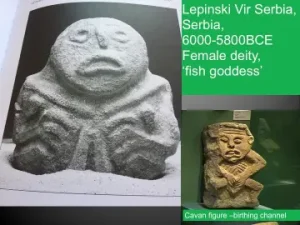
The photo below is from one of these talks I gave on these figures, I used this photo to illustrate the universality of this concern of birth and the regeneration of the tribe, the Magna Mater. It also illustrates the possible antiquity of some of the Irish examples.
Academics will say that they date to the Romanesque carving tradition where carvings populated the corbels of churches and illustrated the perils of the seven deadly sins, however, some of the Irish figures i would suggest date to an earlier ‘pagan’ time and are concerned with the above mentioned regeneration of the tribe.
The figure below on the left dates c.6000BCE and can be seen to share similar characteristics with the Síle Na Gig From Co. Cavan, who may have once enjoyed an elevated position in a castle or a church dating to between 12th-15th century but its also possible that she was carved at an unknown earlier date and reset in the wall as she was held in such high regard by her people!
Published ideas on their name and function.
Many publications have come into the public sphere over the years.
Several writers have offered very interesting yet incomplete explanations of these iconic images.
One to note is Barbara Freitag’s publication ‘Sheela-Na-Gig unravelling an enigma’.
This very thorough analysis of the subject, includes much interesting material relating to all aspects of the topic, and is a necessary read for anyone interested in this fascinating subject.
With regards to the origins of the term ‘Sheela-na-gig’/’Síle-na-gig’, Freitag draws attention to a letter by Nóra Ní Shúilliobháin to the Irish Times in 1977 in which the latter informs us of a British Navy vessel named Sheilanagig, cited in relation to the career of a certain Home Popham, later Rear-Admiral Sir Home Rigges Popham, who according to the dictionary of National Biography was transferred to the ‘Sheilanagig’ in 1781.
Here, the name is interpreted as ’Sheela na Guig’ meaning Irish female sprite. This is interesting on two points. Firstly, it is the earliest published reference to the use of this term Sheila-na-gig, long before it was recorded as a term for these extraordinary sculptures, by the ordnance survey in the 1840’s.
Secondly, the translation of the term is interesting. Generally, the name Sheela is said to be a translation into Irish of the French name Cecilia, brought into Ireland by the Normans, but here we see its association with the term sí or sídh meaning sprite, fairy, otherworld being, like for example the famous oracle of death, the Beansí
This suggests the possibility that the name Sheela/Síle had an indigenous association with a fairy woman or at least ‘otherworldly’ female force.
I would suggest that this name Síle na gig is a nickname, a colloquialism for the powerful Magna Mater, creatrix figure, The Cailleach, as she’s named in the Irish tradition. The divine maternal ancestor, with a geo tectonic role, shaper and protector of the land, who could shapeshift and appear as Maiden, Mother or Crone.
In the 1830’s when antiquarians ‘discovered’ these figures they heard them referred to colloquially as Sile na gig, which, as mentioned, is highly likely to be a modern slang name attached to them, others called them the witch on the wall, again a highly suggestive colloquial reference to them.
It makes me smile that people have now embraced these stone effigies, named Síle na gig, and view her as a Goddess in her own right I would suggest that this is an inaccuracy that needs to be corrected. As someone who has contemplated these iconic images for nearly 40 years, I would like to see them reinstated as the representation of the mother goddess and her life giving and taking properties! She is the great mother who brings us safely into this world or can take life just as easily. She is an expression of such profundity that I feel we need to take a step back and really take in what she represents and is reminding us of. She is not just about rewilding and reclaiming our sexuality or lifting the shameful guilt of the female body, she is all that but so much more, she is the Magna Mater, the one who holds us in birth, in our sovereignty and in our death.
Barbara Freitag’s in her book mentioned above, scoffs at this idea of the tribal land /mother goddess idea, which has been proposed in the past by some of the most progressive writers on the meaning behind these intriguing sculptures.
Writers such as Jack Roberts, Maureen Colcannon, Star Goode have written variations on a theme that centres around the core idea of a Pagan ’Celtic’ tribal goddess background for the origins of Síle Na Gigs. I would like to suggest that the concept is much older than the ‘Celtic’ period and that she is an expression of the magna mater, that has evolved and been distilled through differing cultural ideologies through time.
In particular, there is much discussion around the character described as the ‘loathesome’ hag who features in our early Irish myths, namely ‘The Destruction of Da Derga’s Hostel’ and The Adventure of the Sons of Muigmedóin. This figure has been suggested as representing the inspiration for the origins of these carved figures. The Hag in this context of course represents the goddess of sovereignty who might appear as a young maiden of startling beauty or an old hag of ‘revolting ugliness’.
This can certainly be said to be reflected in the duality of the depiction of these primal haglike figures featuring emaciated ribs, drooping breasts, protruding eyes, tattooing on the face and or body contrasting strongly with the depicted emphasis on the life-giving potential of the entrance to the birth canal, often with an engorged vulva, in the act of giving birth ! An image which could certainly suggest sympathetic magic being offered to a birthing mother, who the church told, was given the pangs of birth as penance for the sin of Eve!
The Hag on the wall and the hag in the story.
Interestingly, in the first mythological story the hag is admitted into the king’s hostel, breaking one of the king’s gessa or taboos, as he should not admit anyone to his palace after dusk, thus breaking of the taboo ultimately leads to his downfall.
In the course of the story he insults the hag and she curses him while ‘standing on one leg with one hand held up in the air’.
Interestingly, a couple of the figures, are depicted standing on one leg, with one hand held up, as if listening to something. The picture below is of a poster that appeared concerning information regarding one of these priceless carvings which was actually stolen from the wall of Kiltinan church and is probably in some private collection somewhere – so if you do see her on the wall of some mansion somewhere, the phone number below probably doesn’t work anymore but you can drop me a line !!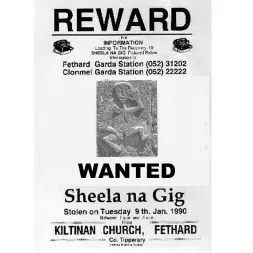
In a second story from the mythological tales, we hear of the encounter of Niall of the Nine Hostages fame (eponymous leader to be) with a ‘loathsome’ hag who by embracing or ’taking to his bosom’ she transforms into the most beautiful stately maiden deeming him the true and just king, completing the hiros gamos, the sacred marriage, uniting territory and its eternal sovereignty principle with the male, mortal ruler.
What is interesting here with regard to our subject is this ability to shapeshift or transform from haggard crone to young maiden which in the folkloric sense fulfills the symbolic process. The goddess symbolises or personifies the land and is inextricably linked with sovereignty and the fertility of the land. It is through the ritual union with her, by the rite of the sacral marriage that the rightful king can institute his legal title to Kingship. When the rightful king becomes apparent as in the story of The Sons of Muigmedóin, in his ritual union with the sovereignty goddess, the kingdom should enjoy great peace, prosperity and health of its crops, animals and people.
This possible association of the early sovereignty goddess with these iconic stone carvings is completely dismissed by Barbara Frietag mainly on the grounds that the descriptions of the physical attributes of the ‘Hag figures’ in the early mythology, do not literally match features or characteristics of the carvings themselves. She goes into great detail telling us about inaccuracies in the translation of certain words referring to specific anatomical features, when in fact what is being described is an archetypal force, which does not have a tick list of features that must be adhered to. This iconic sovereignty figure is a very strong memory in the Irish psyche, that has evolved through time, and survived into modern times as a strong symbol of Irish unity and sovereignty which is something that seems to be missed by Freitag,
It must also be stated that one of the main characteristics of these early writing traditions is the use of exaggeration and hyperbolae. The carvings themselves often appear to have been executed by untrained hands in that they are very crude, almost non-human, each one idiosyncratic and totally unique, while conveying similar characteristics which are deployed to depict a concept rather than a personality.
Sile na gig -Midwife of the Soul-Magna Mater
The original article that I wrote on these iconic figures, was titled Sile na gig- Midwife of the soul, was inspired by characters from our folkloric tradition called ‘The bean feasa’/ ‘bean leighis’ the healer/wise woman. These wise women/healers were exactly that, the midwives of the soul, who administered to those as they were born into and to those as they left the world and everything in between.
The retired professor of folklore at UCD, Gearóid O’ Crualaoich in his impressive study of the Cailleach, the Irish shape shifting Magna Mather, has suggested that these evocative figures -the bean feasa, bean leighis, represent a shared inherited meaning, calling on an ‘archetypal condensation’ of the original figure of the Cailleach and the wise woman, themselves distillations of the ancient Magna Mater, the great Mother Goddess, who would intercede for her people, at pivotal, vulnerable moments of their lives such as birthing and dying, acting as the‘midwife of the soul’.
A message for our times ?
Today along with all the chaos, we are witnessing the rise of the voice of the feminine, at this time of great change and healing, if women rise to take their rightful place alongside the men folk, we just might bring about a world more centered on equal human rights for all, regardless of gender, culture, skin colour, status etc.
Perhaps these carved figures in stone, who represent many things to many people, are a symbol re-emerging in western consciousness, as a signal that the human psyche is responding to the urgent need to restore the repressed feminine.
Perhaps also as an urgent reminder of our need to regard the earth as the sacred source of life itself, as our Magna Mater, the great Mother.
When every mother is valued and held in safety and honoured as the living human vessel through which each one of us is born, then our world will be radically different.
In these times of uber crisis and hopefully paradigm shift, what if every life is sacred and the feminine and masculine energies inside each of us are allowed to come into balance, equally honoured and valued as essential parts of our nature, where gender is not an issue, each one of us honoured as a unique blend of these characteristics, each with our own talents and skills expressed to suit whatever role needs to be fulfilled in the given moment! All life is sacred!
Further reading
- Sheela na gig Sacred Celtic Images of Feminine Divinity -Jack Roberts
- Sheela na Gig The Dark Goddess of Power- Starr Goode
- The book of the Cailleach – Garóid Ó Crualaoich
- The Witch on the Wall – Jorgen Anderson
- Sheela Na Gig, Unravelling a Mystery Barbara Freitag